LEVELS OF REALITY
This Transmissions series of my research blog will document my participation in the Levels of Reality residency, a development programme and group exhibition for artists wishing to produce artistically ambitious work which explores, in a philosophically and scientifically informed way, levels of reality.
Levels of reality is a philosophical term used to explore and problematise the way western science has traditionally categorised different scales and modes of reality into separate levels. For me, the most interesting example of this separation of realities is the distinction made in physics between the quantum and classical physical realms. According to quantum mechanics, it has been shown that the rules of physics operate very differently at the sub atomic scale from at the (classical) scale of molecules and organisms.
During the Levels of Reality residency at Transmission Gallery, I will be exploring the notion of ‘quantum affect’ and how we might become more aware of our quantum nature.
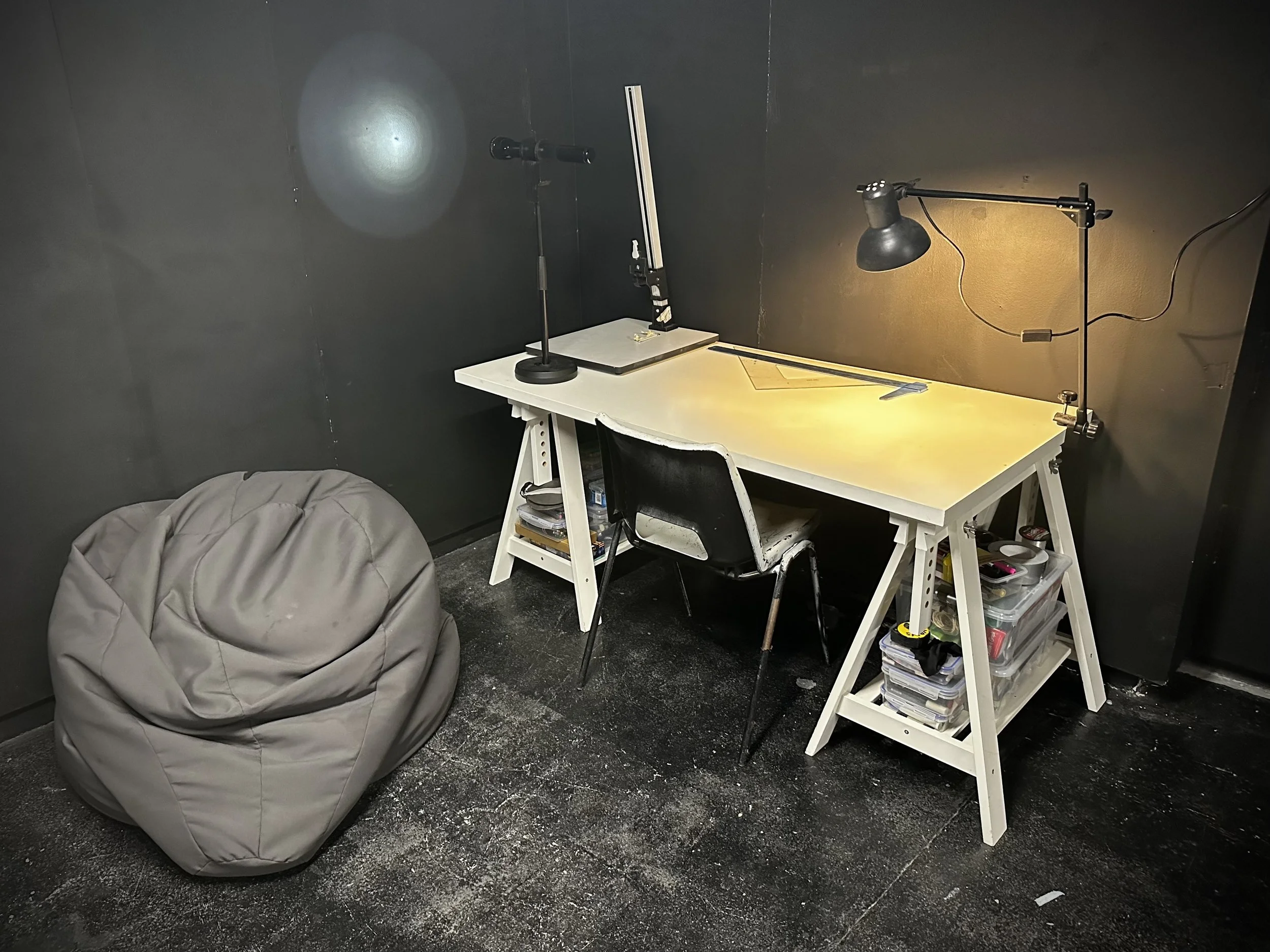
A temporary studio space for Levels artists has been made available in Transmission Gallery’s Trongate 103 premises.
quantum on the inside
Week one of my residency mainly involved theoretical research so this will (hopefully) be the most text heavy entry. I want to keep to hand some of the ideas that have informed my interest in the residency, check out the art that’s being made about it, and establish a basis for my project by noting some of the interesting science that already connects quantum physics to organic life.
All organisms rely on quantum processes at a fundamental level, within the atoms of cells, where particles are able to maintain their stable quantum state due to forces (nuclear/ electromagnetic) that keep the atom together. The quantum behaviour of particles, however, decoheres rapidly in the environment outside the atomic structure. So most of the processes involved in biology are understood through classical rules of physics rather than quantum mechanics. However, there is a growing field - called quantum biology, that has identified instances where animals depend on quantum processes in a substantive way. For example:
Migratory birds: Research suggests the migratory European robin may be able to literally see magnetic fields using a protein in their eyes called cryptochrome. This protein contains magnetically sensitive quantum-entangled particles that are triggered by daylight, enabling the robins to navigate using a visual compass. *
Photosynthesis: When sunlight hits a leaf, the energy travels to the photosynthesis reaction center through a dense network of chlorophyll molecules. It is thought that quantum coherence allows this to happen with near-zero energy loss, spreading out as a probability wave to explore every possible molecular path at once, rather than hopping blindly from molecule to molecule.**
Enzyme reactions: Enzymes speed up chemical reactions in all living cells. To do this quickly enough to sustain life, they often rely on quantum tunneling, allowing protons and electrons to take advantage of the quantum wave function to pass straight through energy barriers rather than climbing over them.***
During my residency, I will speculate on the ways in which human animals might also be Quantum on the Inside and explore how we might become more tangibly attuned to our inner quantum selves through artistic encounters.
*Engel GS, Calhoun TR, Read EL, et al. (2007) Evidence for wavelike energy transfer through quantum coherence in photosynthetic systems. Nature 446(7137): 782-786.
**Ritz T, Adem S and Schulten K (2000) A Model for Photoreceptor-Based Magnetoreception in Birds. Biophysical Journal 78(2): 707-718.
***Devault D (1980) Quantum mechanical tunnelling in biological systems. Quarterly Reviews of Biophysics 13(4): 387-564.
QUANTUM AFFECT
Quantum Aesthetics* is a term coined to describe the new aesthetics that are emerging from quantum technology, often quantum computing. Rather than focus on technology per se, my inspiration will come from biological quantum systems, and explore how they might be understood through the sensing human body. Projects such as Sensing Quantum** - a series of exhibitions commissioned by LAS Art Foundation in Berlin (including artists Pierre Huyghe*** and Laure Prouvost****) demonstrate how contemporary artists are responding to he puzzles and paradoxes of quantum physics, and attempting to make them more accessible to general audiences. Following artists like Prouvost, whose installation We Felt a Star Dying begins with the question “How could we sense reality from a quantum perspective?”, my residency will explore how quantum affect might help us to sense our inner quantum selves.
It has been theorised that certain types of artistic encounter can produce an indeterminate state of sensory and emotional being, known as affect, that is analogous to the indeterminate state of quantum system. Affect, at its simplest, means the capacity to affect and be affected***** but I am using it here, specifically, to describe the pre-linguistic, pre-reflective, relational, emergent ‘in-between-ness’ that is inherent to any encounter******. The affective art encounter is potentially a uniquely open space of possibility where certainty of meaning remains elusive and difficult to articulate. It is this deliberate elusiveness that allows the audience to linger in a kind of resonant uncertainty, prior to meaning becoming ‘owned and recognised’******* and therefore reduced (or collapsed) to a singular, determined outcome.
*Liu ICH and Chen H-Y (2026) Roadmap to Quantum Aesthetics. PREPRINT. DOI: 10.48550/arxiv.2602.08363.
**Foundation LA (2026 (ongoing)) Sensing Quantum. Available at: https://www.las-art.foundation/explore/sensing-quantum (accessed 18 November).
***Huyghe P (2026) Liminals. Berlin: LAS.
****Prouvost L (2025) We Felt a Star Dying. Kraftwerk Berlin: LAS Art Foundation
*****Massumi B (2011) Affect in the Key of Politics. Identities 8(1): 37-44.
******Gregg M and Seigworth GJ (2010) The Affect Theory Reader. Durham [N.C.] ;: Duke University Press.
*******Massumi B (2002) Parables for the Virtual: Movement, Affect, Sensation. Duke University Press. p30
NOTES
Decoherence (Losing quantum "weirdness"): Decoherence happens when a quantum system bumps into its surrounding environment (like warm air, light, or water molecules). This interaction scrambles the delicate phase relationships of the quantum wave, destroying its ability to interfere with itself. After decoherence, the system stops acting like a single unified wave and behaves like a collection of ordinary classical probabilities—even though a single outcome hasn't necessarily been chosen yet.
Collapse (Picking one outcome): Wavefunction collapse is the moment a quantum system settles on one single, definite result out of all its possibilities (for example, an electron landing on one specific spot on a detector screen, or an exciton finally being captured by one reaction center).
*Google AI helpfully summarised this distinction for me.
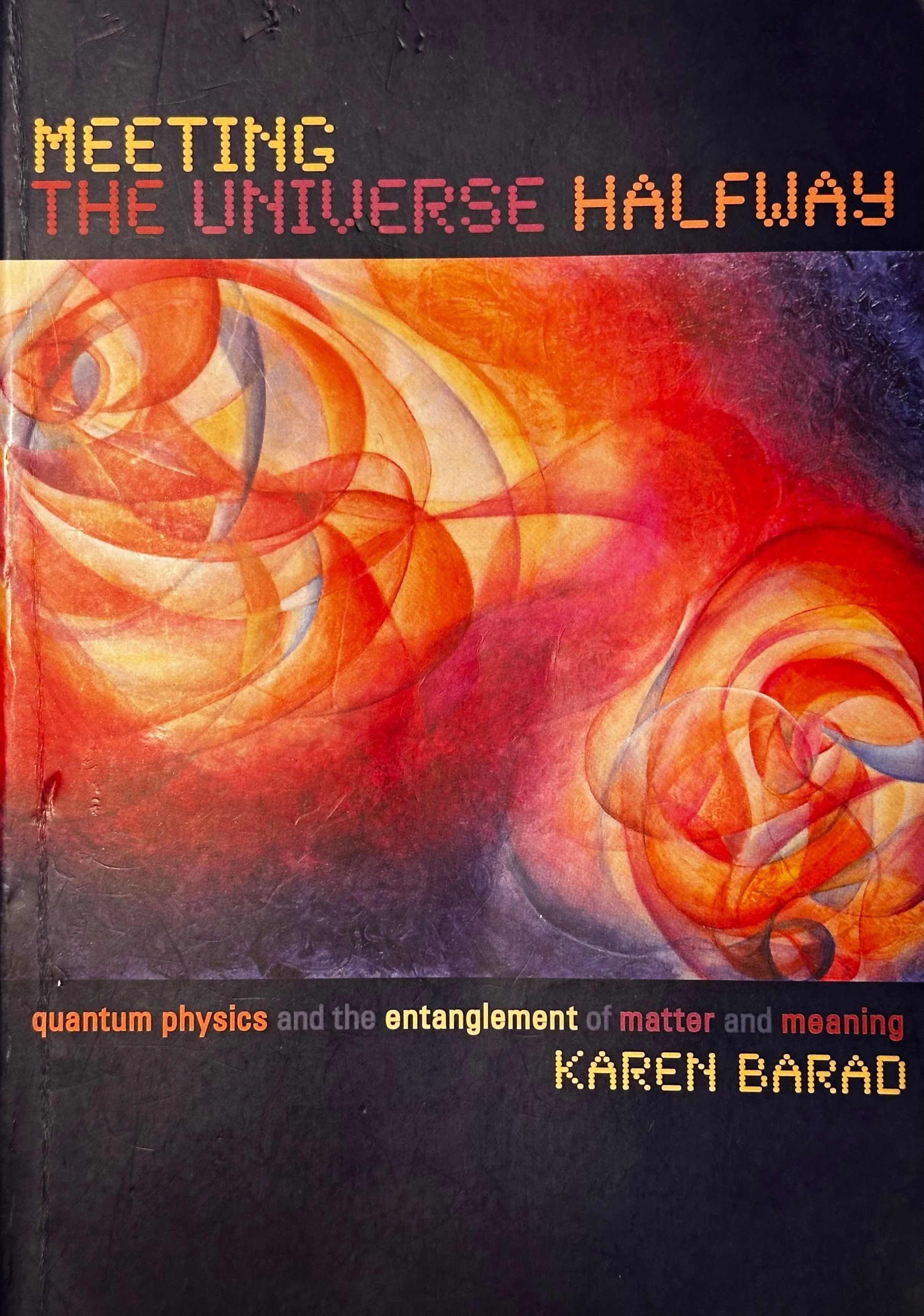
NB: My favourite resource on quantum physics-based metaphysics is Barad K (2007) Meeting the Universe Halfway: Quantum Physics and the Entanglement of Matter and Meaning. Durham, N.C.: Duke University Press.
Questions
One approach that interests me might be to understand levels of reality as analogous to pitch in music. If notes or frequencies are levels, then:
What is a chord?
Where are harmonies?
Is the harmonic of a note really a part of that note or an emergent property of its interaction with something?
If sound waves interfere and cancel each other out, are the cancelled parts of the wave still present as potentialities? Do we still imagine them?
Can you hear what is not present?
strategies
Sculptural tools for thinking with sound waves
Sonification (octave folding for composing with wide frequency ranges)
Animation (2d to 4d)
Drawing/ diagramming